2013 
Bloom Blog

Wildflower/Waterfall Reports


Please send us your  wildflower viewing reports and photos. 
 
Wildflower/Waterfall Tours
 

Plumas County Wildflowers Page

Read Bloom Blog from 2012


Hello, and welcome to the Plumas County "Bloom Blog" and waterfalls viewing page!
Our goal is to keep wildflower/waterfall enthusiasts informed about where specific wildflowers and waterfalls can be found throughout Plumas County. Please send us your own sightings and photos! And don't forget the species identification, if you know it!

Watercolor courtesy: Linda Blum    


(Please click on any image to see a larger version)


June 19, 2013 - Joe Willis has been out and about again. His report from yesterday follows. And by the way, be sure to click on the photos to see the detail in his pictures - awesome!

Now blooming in the lower parts of Feather River Canyon around Jarbo Gap and in various spots between Spring Garden and Blairsden. I include a close-up of the flower and a view of the whole bush as it looks from a car at 55 mph - Blazing Star.

Here are some of my latest findings. There are many species of wildflowers blooming now, but I'm only sending the ones that are easy to spot. If you crawl around on hands and knees you discover whole new worlds and many more species. The tiny and hidden ones I tend to write about on my blog, blackoaknaturalist.

First, here are our two prominent lilies, Leopard Lily and Washington Lily. Very similar size and shape, but one is orange and the other is white. Always found in the shade and/or near running water. I found the Washington Lily near Lee Summit in a shady place on the South side of the road. The Leopard Lily was photographed this morning by Berry Creek where it emerges from under the railroad track in the Oakland Camp area.


Today I'm including a close-up view of Water Plantain taken in a wet spot along the road into camp. It'll be hard to find them now because the county road department came by with their monstrous weed eater. They wiped out about 90% of the wildflowers I photographed last week. Not sure what was accomplished by that.

The Rose Campion is widely domesticated. There's a nice batch outside Quincy Natural Foods, and I'm finding them here and there in the forest. Today's specimen was in a bushy are near the northern end of Oakland Camp.


The Self-heal and Mullein were found along Tollgate Creek about a half mile upstream from Oakland Camp,


and the Hooker's Evening Primrose is growing out of a crack in the pavement near the Mailbox on Main Street outside Dunn's Coffee Shop.


Be sure to check out my recent blog entries on bugs making more bugs. Warning: x-rated.


June 18, 2013 - Mike Nellor checked in today with a brief report on the Rock Creek area. Rock Creek is just off Bucks Lake Road just out of Quincy. His report:

Here is what's happening out at Rock Creek.

The Washington Lilies and penny royal are really starting to show on the upside.

and wild roses, tiger lilies and azaleas are showing creek side.


June 16, 2013
- Another album of photos from Joe Willis. (below) He reminds us at the end of the report to be sure to check out his blog - Blackoak Naturalist, for more extensive reports:

Here are two that I spotted in Feather River Canyon last Friday. The Gumplant is easily and safely viewed at several turnouts between the Pulga Bridge and Jarbo Gap. The Spicebush, however, is a bit more precarious in the region of the three tunnels. I spotted it in two or three places where it is unsafe to stop. If you're as determined as I was to get some photos of it, please find a safe turnout and walk back to the bush. Even then, be careful walking, maybe on the river side of the guardrail when available. It's not just that you don't want to get hit. You should be mindful of not spooking the drivers of large trucks and motor homes. Both of these plants are worth the effort.

Today's flowers were all seen along the road to and through Oakland Camp or along Quincy Junction Road on the way back.The roadsides around American Valley have a good variety of wildflowers blooming, both native and non-native, but one must keep ahead of the weed eaters and mowers.

On many occasions throughout each summer I get attached to the progress of certain flowers and their insect and spider companions only to find them victims of someone else's idea of neatness and order. I prefer the wild.

The hot spot, for me, that is not subject to mowing and weed eaters, is the dirt road that passes beyond Oakland Camp in a northerly direction, then turns westward on the way to the Gilson Creek crossing and beyond for another quarter mile. All but two of these photos were taken along that stretch. Only the Butter and Eggs and Bachelor's Buttons were taken at the side of Quincy Junction Road. I should explain that the one I'm calling Butter and Eggs is also called Toadflax and is not a native plant. But there is a different flower, already gone to seed, that is a native and is locally known as Butter and Eggs or Johnny Tuck. The former is Linaria vulgaris while the latter is Orthocarpus erianthus. Most of the photos in this set will also appear on my blog but with more extensive commentary.

Bachelor's Buttons Gay Penstemon Water Plaintain Indian Hemp
Mountain Pennyroyal Narrow Leaf Milkweed Sierra Stickseed Spreading Dogbane
Blue Elderberry Harvest Brodiaea Butter and Eggs


Also coming soon, for those who can appreciate the drama that takes place in, on, and around wildflowers, is a set of insects mating.


June 14, 2013
- We received a ton of photos from Joe Willis yesterday. They're posted below with identifications. And if any of you have been curious to see the person who sends all these great photos and reports, Joe included a photo of himself with a gopher snake. Joe's report:

These were taken along the dirt road bordering the North side of Spanish Creek between the North end fo Oakland Camp and the Gilson Creek crossing of that road. It's a distance of around 3/4 mile and it's mostly open pine forest with lots of sun exposure.

There must be 50 or more species of flowers blooming and a rapid increase in the variety of insect and spider visitors. We also caught a gopher snake and some lizards. I'm just including the larger blooms that one can spot while walking fast or driving. If you crawl around on the ground or walk very slowly you'll discover many more species. The photo of me and the gopher snake was taken by my son Ryan.

Crimson Columbine Douglas's Spirea Leopard Lily Gopher Snake
Showy Milkweed St. John's Wort Wild Hyacinth
Grand Collomia Mountain Pennyroyal Self-heal Scarlet Gilia
Narrow-leaf Milkweed Showy Milkweed Yerba Santa


June 12, 2013 - Received this nice photo from Barbara Steinberg of California Travel Insider.

She visited Plumas County and the Lake Davis Recreation Area over the weekend and shared this beautiful shot of wildflowers with the lake in the background. Thanks Barbara!


June 8, 2013 - We're so lucky Joe Willis takes his camera almost everywhere he goes. His report: I needed to do an errand in Meadow Valley around noon, so I brought my camera in hopes of spotting some new wildflowers blooming along the way.

Sure enough, there was one specimen of Indian Pink shining like a red beacon and I spotted it while driving around a bend at 45 mph. It's an unusually bright red that stood out even though surrounded by many Indian Paintbrush. The challenge was finding a safe place to park.

When I walked back for a photo I saw other flowers blooming that were not so obvious while driving. This included some small Yarrow. They'll grow much taller before summer's end. Then I found some very small Farewell-to-Spring. Several species of Clarkia are known as Farewell-to-Spring in different regions, but I'm pretty sure this one is Clarkia dudleyana which is also known as Dudley's Clarkia.


There were lots of the small wild pea vine known as Vetch, and I found my first Showy Milkweed of the season. Only around a third of the buds on each plant had opened at this time, so there's lots more blooming ahead. This plant has a great fragrance, more or less like fresh peaches, and it plays host to a wonderful variety of beetles and spiders as well as some "true bugs."

A good example of the latter shown here is the Spotted Assassin Bug.


June 7, 2013 - Joe Willis went for what we think must be his favorite walk in Quincy yesterday, and sent this report and photos:

A quick walk up Boyle Ravine today revealed lots of great flowers, despite the intense heat. I'm actually looking forward to some thunder showers which are in the forecast. Meanwhile, here are a few that got my attention.

The Wild Ginger blooms close to the ground underneath the rather large over lapping leaves, so one needs to know where to look. I've shown where I pushed some leaves aside with my left hand and got the shot with my right, then moved in for a close-up. A really beautiful flower that is mostly overlooked.

The Prince's Pine is blooming and is in the same family as Manzanita, Madrone, and Wintergreen.

The Spotted Coralroot are nearing the time for wilting and development of seed pods, but there are still a few blooming in the damp, shady areas.


The Blue-eyed Grass, a close relative of Irises, is blooming near the backside of the water tanks. It generally does well near small leaks.


Along Boyle Creek in the shade, usually above the leaves of the Wild Ginger, are some Crimson Columbine, in the Buttercup family.


And, there are daisies everywhere. When they're that abundant, it's hard to single one out as special, except when there's some insect drama going on. Here's one with a pair of attractive green bugs mating. While I was photographing this, a butterfly and a beetle made brief visits.


June 5, 2013 - We have an unusual report from Joe Willis to start the day today:
 

I usually pay attention mostly to wildflowers away from town, but this one, in several yards in downtown Quincy, has gotten the attention of a couple of real botanists and me.  I took some doing, but I finally identified it as Love-in-a-Mist, Nigella damascena.  It's not a native, and none of the people in whose yards I found it knew what it was. 

To a nursery person who has this in their inventory, it's probably a no-brainer, but to us it was an exotic worthy of our attention.  It's in the Buttercup family, Ranunculaeae, which was also remarkable.  Doesn't look much like a buttercup.


Here are some photos from my trip to Butterfly Valley Botanical Area last Sunday.

The first five photos were taken in a relatively dry area uphill from the popular bog that features the Pitcher Plant and Sundew. I went there in search of the Beargrass based on directions from a friend who lives in Butterfly Valley.

We found the Beargrass and nearby the Fleabane Daisy, the Pacific Starflower and the Wood Violet. The remaining five, along with the last six, were in and around the bog area.

Pitcher Plant Sundew Beargrass Beargrass
Fleabane Daisy Pacific Starflower Wood Violet Blue-eyed Grass
Labrador Tea Macloskey's Violet


Here are six more flowers from the bog area at Butterfly Valley Botanical Area and a butterfly known as a Comma. It's as pretty as any flower, so I thought I'd include it. I had limited time for this outing, but there were dozens of other species blooming. Several orchids and other lilies, Monkeyflowers, Penstemons, and more. Visit before it gets too hot and dry.

Comma American Dogwood Camas Lily
Interior Rose Leopard Lily Western Azalea


June 4, 2013 - Karen Kleven was kind enough to send two more photos to add to her report about hiking in the Lakes Basin area.


The first is a photo of the snow plants she mentioned yesterday. The second looks soooo inviting! Big Bear Lake - don't you want to jump in? Please be sure to click on the lake photo - you'll be happy you did so.


June 3, 2013 - Karen Kleven checked in again, this time from the Lakes Basin Recreation Area in Eastern Plumas County:
 

Spent a lovely afternoon in the Lakes Basin area near Graeagle yesterday. The flowers are very early because of very low snowfall but certainly not at the peak. I saw some Indian Paintbrush and one of my favorites, a few snow plants, taking the Round Lake Trail toward Big Bear Lake.


June 2, 2013
- A new report from Joe Willis. This one is about Boyle Ravine just out of Quincy.

Boyle Ravine and vicinity is getting more interesting every day. Especially the small, delicate flowers that are easy to miss on a walk, but are very intricate when viewed close up.

The Lemmon's Catchfly is a case in point. It's a member of the Pink family which includes carnations. Can you see the resemblance?

Then there's the Fringe Cups, a saxifrage growing in the shade right next to Boyle Creek.

The Thimbleberry are in full bloom everywhere in dense patches, but I thought this "stand alone" was very photogenic.


The Interior Rose is common now in the ravine and is hosting many insect visitors including bees of course.


One of my favorites along the trail is the Spotted Coral Root, one of several wild orchids in our local forests.

The Prince's Pine is in the same family as our Manzanita and Madrone.


The Sierra Nevada Pea, a species of Lathyrus like the larger and more common roadside peas.

The Naked Mariposa Lily, Calochortus nudus, hybridizes with other Mariposa Lilies and they all are known by several common names such as Star Tulip, Beaver Tail, Pussy Ears, etc. You can count on the technical name to refer to only one type of flower.


Last, for some ecological excitement, I thought I saw an upside-down butterfly on a Red Clover. Turns out I did. It was dead and was having its body fluids drained by a Goldenrod Crab Spider. I'll be posting more technical information about all of these on my blog, Blackoaknaturalist.


May 31, 2013 - Wow, is spring ever going by quickly! Fortunately, we have great wildflower reporters to keep us in the know around the county.  Today we have another report from Joe Willis:


I took a drive out to Greenhorn Ranch on Tuesday and drove to Grass Valley on Wednesday. Here are the highlights of my wildflower sightings from Quincy to the Gold Lake Road area combined into one set of photos.

The Lupine holding dew drops caught my eye more than the blossoms and it, along with the three different colors of Larkspurs, were on the Greenhorn Ranch road about half way between Highway 70 and the Ranch office.


There was a break in the forest on the right hand side of the road where a meadow of about a quarter acre had all these colors of Larkspur. I wondered if they were cultivars spread along the roadsides by the highway department as I've never seen all these colors in one place in the wild.


Around the new development going in near the western end of Chandler Road there are quite a few flowers blooming that definitely appear to be cultivars planted by humans as I've never seen these before the roads were cut into the hill. The beautiful purple one I haven't identified.

Then there were lots of Tidy Tips and Madia in that same area.

 
Salsify are blooming all around American Valley and out by Oakland Camp. This particular one with the insect visiting was photographed by the eastern end of Chandler Road. The rest of these were photographed along Gold Lake Road.


The Mountain Pride, a Penstemon, was near the summit and was growing out of cracks in the rock walls on either side of the road.


Choke Cherry was blooming abundantly on both sides of the road and was giving off a very strong and pleasant (to me) aroma.


There was Groundsel along both sides of the road in spots that had more soil. This is in the sunflower family and resembles some of the Goldenrods.

 
The Crimson Columbine was spotted in several wet areas on the Sierra County end of Gold Lake Road,


and Pussy Paws were growing out of the drier areas of decomposed granite (DG in road crew language) also on the Sierra County side, but probably blooming in many places in the Lakes Basin now.


I also photographed many species along Highway 49 from Sierra City to Grass Valley, since they weren't in our immediate area, I'll feature them on my blog, blackoaknaturalist, but all of them do grow in Plumas County except for the KitKitDizze.


May 29, 2013 - Mike Nellor from Ada's Place checked in again today with some great photos. 

He writes: What a year so far for wild flowers. I thought with our lack of snow this winter and dry spring the flowers would be scarce.....surprise!

The azaleas are just starting to show at Rock Creek; and on the hike down there are an abundance of snow flowers, beaver tail, tulips, and monument flowers. I have never seen so many. What a surprise and treat!!


May 27, 2013 - Joe Willis
returns to report on his trip in the Oakland Camp area:


On my way out to Oakland Camp I stopped in the woods at the top of the hill a mile past the college and found some nice specimens of Hartweg's Iris, the most common Iris found in the woods around here.  There was also a lot of Checker Bloom, Buttercup, and Cinquefoil that have been featured here before.  The Fritillary seem to be gone for the season at this altitude.


In this same spot I found Mule's Ears, but they're all over the place now, including around Oakland Camp.  One photo emphasizes the beauty of the flower and the other shows the shed skin of a Cicada.  Sorry, I can't help but include insect artifacts that fascinate me.


The first flowers I saw when I hiked the South end of the Keddie Cascades Trail [which begins near the bridge on the Oakland Camp Road] was the American Dogwood.  They're abundant along both sides of Spanish Creek.


There's lots of fully-flowering Deer Brush in this area, but I was taken by the standout Ladybug on a cluster of buds.  This bush was mostly in the shade and hadn't begun blooming yet.

Then, camouflaged in the grass near the creek I saw several patches of Death Camus, a Lily.

Along the path by the creek there were lots of different species of wild peas and here I have included the Sulfur-flowered Pea.


The Sticky Cinquefoil are out in abundance and have appeared in this blog earlier, but I include this one - you guessed it - because of the dramatic-looking fly visiting.  I haven't identified the species.

Likewise, Arnica has been shown here before, but this one is hosting a real feast of small beetles of some kind.  Unlike in most of my photos, this time the beetles are definitely consuming the flower.


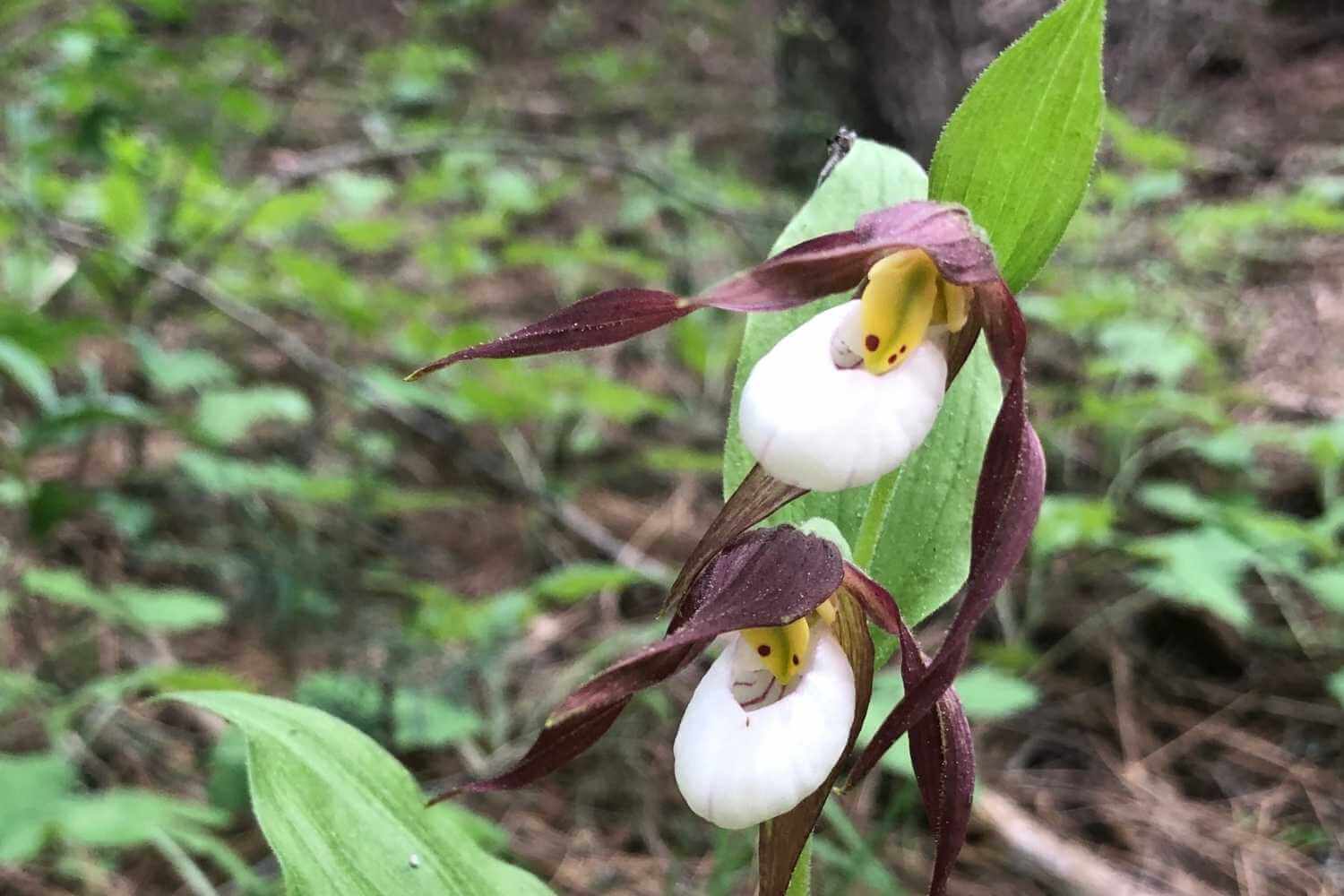
On my return to the car, I met up with a couple of Quincy people who were interested in what I was doing, so I hiked across the bridge with them and showed them the spot where the Mountain Lady's Slippers are still blooming as well as the Spotted Coral Root, both being wild orchids.


May 26, 2013 - As promised, here's more of Joe's report from around the Quincy area:


Pineapple Weed is a roadside and sidewalk favorite. Squeeze the flower head and you'll detect a strong and pleasing aroma resembling pineapple. The so-called head is actually a dense cluster of perhaps hundreds of disc flowers. The ray flowers, such as the white petals of daisies, are lacking. It's one of the peculiarities of the sunflower or aster family. Some species have both disc and ray flowers (daisies), some have only ray flowers, and still others have only disc flowers.


I've doubled up on each of the next three flowers because of the interesting bug visitors or the need to clarify what the whole plant looks like as well as a close-up of the individual flowers.

The Ox-eye Daisy, also known as Shasta Daisy (when you're nearer to Mt. Shasta, I presume) is in the genus Chrysanthemum. The first photo shows a visitor known as the Common Checkered Clerid beetle, one of our commonest and prettiest beetles now visiting many different species of flowers around American Valley. The second daisy photo shows the Dimorphic Flower Longhorn beetle. This one is less common, and the one shown is a female. The male of the species is entirely black and only about half as big.

The two photos of the Bush Monkeyflower were taken between Storrie and Pulga in the canyon a few days ago. They're peaking or just past peaking in most places in the canyon, but fresher ones may be found at slightly higher elevations.


Last, the Gumplant, with and without a visitor, photographed near the Entering Plumas National Forest sign just East of Jarbo Gap. They should be blooming in American Valley soon.


May 25, 2013 - More of Joe Willis' (blackoaknaturalist) reports:

 
Here are my promised photos from Quincy area roadsides taken over the past week.

There are several flowers blooming that were once called Brodiaea and in the lily family. The most spectacular-looking one, to me, is now known as Wild Hyacinth and is no longer Brodiaea but is Dichelostemma. I photographed these between the North end of Oakland Camp and Gilson Creek, in the same area as my last set of photos blogged here.

The plant known by my Maidu friend as Indian Licorice is definitely a member of the carrot family, Apiaceae, but I can't pin down its scientific name. We have lots of carrot family plants around here with clusters of small white flowers and pinnately compound leaves. That includes Brewer's Angelica, Cow Parsnip, Fennel, and the Poison Hemlock. Some edible, many fragrant, and some deadly. Don't mess around unless you're an expert or accompanied by one.

The Yellow Salsify, also known as Goat's Beard and Oyster Plant, is in the Aster or Sunflower family. Blooming on roadsides all around Quincy, and this morning I saw quite a few on the Keddie Cascades Trail. One of my favorites for the variety of insects and spiders it attracts, including great herds of aphids guarded by ant "cowboys." Details of that story will be on my blog before day's end.

The Bachelor's Buttons bloom in many colors, blue being the most common. I've also seen white, purple, and mottled. It's a pretty flower and there are many cultivated varieties. I get a kick out of knowing it's in the same genus, Centaurea, as the unpopular StarThistle.

Rose Clover is one of many roadside clovers variously known as forage or invasive weeds. Sometimes it's found in dense mats for hundreds of yards along the sides of roads and in unplowed fields.


Finally, a plant that's usually always dismissed as an uninteresting weed is the English Plantain. I find the close-up view, especially in low light, to be an attractive photo subject. Break one of its long leaves with parallel veins and you'll discover the feel of lengthwise rubber bands. My pet rabbits used to love plantain. [Seven more in my next post]


May 23, 2013 - Joe Willis continues:

Here are a few more flowers seen blooming between Oakland Camp and Gilson Creek last Friday. New species are coming into bloom in rapid succession, so I'll probably go out there again next Saturday. Meanwhile, I also have to report on a drive around American Valley and a drive down Feather River Canyon yesterday.

The Farewell-to-Spring, of which I've only seen one bloom, is in the Genus Clarkia as is the Diamond Clarkia. I also saw only one of those. There should be more of both blooming soon along Tollgate Creek.

The very tiny Spanish Clover is almost impossible to spot unless you know it exists and know where to look. If you don't mind crawling around on the ground, you'll be rewarded by a very pretty little pea-like flower. It is in the same family as peas, Fabaceae.

I found one patch of Yarrow blooming near the corral at the entrance to Oakland Camp, and it had a Longhorn Beetle visiting.

Finally, the Sierra Wild Rose are blooming here and there by most of the creeks at the Quincy elevation. I found this one along the road between the bridge over Spanish Creek and the camp entrance.

Next report will be Quincy roadsides.

May 23, 2013 - As promised, here is more of Joe's report:

Here's the second installment of my report from last Friday's outing beyond Oakland Camp. The most prominent color against the brown leaves and pine needles on the ground is the yellow of the daisy-like flower known as Arnica.

I've shown a whole plant as seen from a distance of 10 feet or so outside my car window and a close-up of the blooms. A more complete report on my blog, blackoaknaturalist, includes additional views with some beautiful insect visitors.


The Yerba Santa plants look rather scrawny compared to the ones I saw down the canyon a few days later, but the individual blooms are pretty. The leaves make a good and nutritious tea.

It's Milkweed time, and the first species to bloom is the Heart-leaf or Purple Milkweed. Here I show a view of a whole plant from a distance of 10 feet or so as well as a couple of close-ups of the beautiful and complex blossoms.

There are more views of this one on my blog as well as shots of other kinds of milkweeds that are just starting to bloom.


Finally, the Blue Gilia has tight clusters of tiny blue to white blossoms on top of tall, naked stems. Groups of them rising above the surrounding grasses are quite dramatic looking. There are a few other species of flowers blooming among them, and I'll send those along with my next report.


May 18, 2013 - Joe Willis continues:


I heard from a friend that the Mountain Lady Slippers were blooming in a fairly remote area on Taylor Creek, so I thought I'd check the place I first discovered them several summers ago on the road into Oakland Camp. I really didn't expect to see them blooming, but I was pleasantly surprised. There were a dozen or more plants in a small area about 50 feet off the road. Several were bearing more than one blossom.


In this same dark, shady spot under huge Douglas-firs, there was also lost of False Solomon's Seal. Right at the road's edge there was lots of Western Dog Violet. These are small plants and difficult to spot when the surrounding wild grasses and Mugwort get tall. It's the only violet around here I know of that's actually violet. Well, maybe blue. Most other species are yellow and one local species is white.


Down the road a piece where there' less shade, I found lots of Sticky Cinquefoil. This is a common and very hardy roadside wildflower around the Quincy area.

The Mugwort, a close relative of Sagebrush, was not yet blooming, but even when it is the flowers are so small they go unnoticed. To make it more attractive, I managed to get some photos of Skippers resting on it. This is an insect that is not quite a butterfly and not quite a moth, but an intermediate category.

Another common roadside flower in the sunny and dry areas is the Rose Clover. This non-native often grows in extensive patches for hundreds of yards along roadsides.


The Red Larkspur which first appeared in this blog a couple of weeks ago, is now abundant, especially in shady areas.


Also beginning to appear in many places is the Orchard Morning Glory, known by people who don't like it as Bindweed.


I drove past Oakland Camp, and when I got to the stretch of road that heads West toward Gilson Creek, I was excited to find just one specimen of Diamond Clarkia. This is in the same genus as Farewell-to-Spring which I found a little later on and will appear in Part 2 of this report.

It's already looking very dry in the forests, but if you walk around and look carefully, there are actually quite a few species of wildflowers blooming. I just hope we get a few more rains before summer gets serious.


May 17, 2013 -
Here's Joe's report for today so far. Stay tuned for more to come........

Saw my first blooming Scotch Broom of the season this week. It is by the college turnoff, not a safe place to park. I just posted a story, an editorial really, about the Scotch Broom on my blog, blackoaknaturalist. It's a non-native species that in many areas it is considered invasive. I happen to like the plant. It has a great fragrance, more or less like peaches, and when it goes to seed, the black pods, when dry, explode with a loud crack and send the seeds flying quite a distance.

Then, on a trip to Reno yesterday I saw lots of Birdcage Evening Primrose blooming on the South side of the highway between Vinton and Chilcoot.


I had a great walk yesterday in the area North of Oakland Camp toward Gilson Creek. Got lots of photos which I'll send later today. The most exciting of which are the Mountain Lady Slipper. This is the earliest I've ever seen them blooming. Scary omen for a dry summer.


May 15, 2013 - Joe Willis sent along some good advice today. He writes: To enjoy daisies.....


......do this. Bring a portable chair or pillow and plan on staying a while. You will find daisies play host to an incredible variety of flying and crawling insects, spiders, and birds. When you see a butterfly land on a daisy, it is usually futile to approach it quickly with your camera or sketchbook. It's best, when you see insect activity in the vicinity of daisies, to sit still, maybe just a few feet away from a patch of daisies and wait. Interesting things will happen. If nothing happens on or around a daisy, things will happen in your mind. It'll be worthwhile.

This photo was taken yesterday in the field on Golden Eagle Avenue just below the Courthouse Annex building.


May 13, 2013 - Karen Kleven checked in again with this note and photo:
 

I came up the Feather River Canyon yesterday after a very nice Mother's Day in San Francisco with my daughter and was glad to see the ongoing monkey flower show. Starts at about Belden and continues down the canyon until Yankee Hill. Amazing how they can bloom out of the rocks. May not last too much longer.


May 11, 2013 -  OK all you Bloom Blog followers, here's the last installment from Joe's explorations this past week:

Beginning to bloom in many places along the roadsides, the California Waterleaf was the last bloom I saw as I left Old Highway and headed toward the Greenville Y. I include here a view of the whole plant and a close-up of the flowers. Sometimes these get blueish or purple, but mostly white.

My next stop was at the foot of Butterfly Valley Road where Butterfly Creek cascades along side it. Here's a view from the creek bed looking upstream. Many young leaves of Umbrella Plant are seen at the edge of the pool. Slightly downstream from the pool were a few still in bloom. Still commonly known as Indian Rhubarb, it is a Saxifrage, and the name is changing in more and more field guides to Umbrella Plant.

When I got to my favorite stopping place just north of the Y, I was greeted by a group of Western Fence Lizards, AKA Bluebellies, in courtship mode. They were playing chase, nipping at each other, doing pushups, and possibly trying to defend their territory from me! This one was so absorbed in his courtship rites that he let me get up really close and continued to do pushups.

I moved on anyway, and found the Serviceberry Bushes in full bloom. They are in the Rose family as is the Sticky Cinquefoil which was growing out of cracks in the rocks.


When I got further down into the small canyon formed for sedimentary rocks turned vertical, I found lots of Lupine blooming as well as a few plants that had already gone to seed.

There were a few Elegant Rock Cress still blooming, but wilting fast and not very photogenic.

On the way home I stopped by a dogwood tree just south of the new Spanish Creek Bridge. There's a relatively safe turnout at this spot and I'll bet this is one of the most photographed dogwoods in the county.


The close-up of a blossom is actually quite a few individual flowers in the central cluster. The large white things most people call petals are actually bracts. It's built more or less like a Sunflower.


May 10, 2013 - True to his word, Joe Willis sent along another report with some great wildflower shots. This is the second of three parts - be sure to check back for the rest of Joe's report!


Here are six more flowers blooming along Old Highway. All the photos in this report were taken along the last 1/4 mile of Old Highway before the turnoff to Keddie Cascades Trail.
 
The False Solomon's Seal were growing on a steep slope above the road. I liked how they were lined up along the crest as if to attack, so I took one panoramic shot. I then scrambled up the slope to get a close-up of the flowers.


Same with the Arrowleaf Balsamroot. One distant shot of the whole plant, showing the arrow-shaped leaves, and one close-up of the flower (which is actually a cluster of several hundred flowers).
 

The Wallflower and Sierra Stonecrop were growing among the rocks above the road while the
 

Pacific Starflower were growing on flat ground with more soil. They're hard to spot as they blend in with lots of other greenery and small white flowers. More to come. This is a very rich area when it comes to wildflowers.


May 9, 2013 Another report to post today. Joe Willis submitted this report and beautiful photos. (We found a new favorite - check out the Woodland Star!)


I took a short drive yesterday from Quincy to the Greenville Y via Old Highway and found lots of wildflowers blooming. The recent combinations of rain and sun have really launched Bloom Blog season in a big way. This is the first of two reports on yesterday's findings.

The Scarlet Fritillary were in the woods on the right hand side at the top of the hill just out of Quincy past the college. The hill might have a name, but I don't know what it is. I'm sure the Fritillary are blooming in many other comparable places such as around Oakland Camp, out on La Porte Road, and towards Spring Garden.


All the others in this batch were found along the sides of Old Highway from the turnoff 4 miles north of Quincy to the hairpin turn by the Keddie Cascades Trail turnoff. In most cases, while driving at a snail's pace, I would spot only one colorful bloom then get out to photograph it. Only on foot would I discover the many others. There are a few spots I visit every spring and familiarity with them makes it easier to spot the blooms.

Checker Bloom Death Camas Spotted Coralroot
Jepsen's Pea Sulfur Flowered Pea Woodland Star


Some people want to drive faster, so be careful out there that you're not obstructing business-as-usual.

May 9, 2013
Received a nice bloom report from Karen Kleven yesterday.
 

Dogwood are in full bloom in the mountains behind Quincy. Take Coburn to the end and enter the Quincy Community Service District property. Nice dirt road with lots of maples leafing out, interspersed with dogwood and lots of evergreens. Nice thunderstorms this week with much appreciated rain made the walk even nicer.


May 8, 2013
Mike Nellor
, from Ada's Place in Quincy, took the short drive to Snake Lake yesterday and sent this note and photos: 
 

Two surprises from Snake Lake today! The dogwoods are blooming as well as the native Iris.


May 7, 2013
So nice to hear from our friend Richard McCutcheon this morning. He always sends the nicest shots from the Taylorsville/Indian Valley area. He sent along these photos and this note:
 

Up in the high country the wild flowers are pretty. Lots of Yellow Bells, not all triple like this one.


And wild Violets and yellow flowers all over the mountainside.


May 5, 2013
Received this note from Joe Willis:

Got lucky on a walk down Boyle Street this morning. I got within a foot of a Two-tailed Swallowtail butterfly just as it landed on a Lilac bush. I don't usually submit photos of domesticated flowers, but the butterfly was too much to resist. I'm putting it on my blog under the title Complementary Colors.


May 3, 2013
Joe Willis
was out and about Quincy and sent this report:


I took a short hike up Boyle Ravine today and was delighted to find the Lemmon's Wild Ginger blooming. I've included several photos of it here to show not only the beauty of the blossom but also the fact that it grows out of the base of the leaf stems and is hidden by the large, heart-shaped leaves.


Also blooming was the Stream Violet, Viola glabella, one of several species of yellow violets that grow around here.


Finally, the Oregon-grape is looking healthy not only in yards around town but in the forest. There are many other species of wildflowers in Boyle Ravine that are almost ready to bloom, including the Scarlet Fritillary, the Leopard Lily, and False Solomon's Seal. TIny flowers already blooming include Bedstraw and Blue-eyed Mary.


May 1, 2013

Here we are on the first day of May. It seems as though April flew by - the weather has been beautiful - just right to take your camera and explore not only along the highways, but off-road too - to find some of the wonderful wildflowers shown on this page.

Today's report from Joe Willis is informative, as usual. Be sure to click on any photo to see more detail.

Went to Oakland Camp and beyond on Sunday in search of Scarlet Fritillary. Actually, to see anything interesting and check on the status of spring.

What I didn't expect was to come across the much less common Fritillary known as Brown Bells. Both species are of the genus Fritillaria. The Scarlet Fritillary is Fritillaria recurva and the Brown Bells is Fritillaria micrantha. To make matters more confusing, Fritillary is also the name of a category of butterflies.


My only photo of the Scarlet Fritillary was one that hasn't opened yet. But today, driving near Greenville, I saw a few blooming. But I didn't have my camera with me.

Another common confusion is that between Mule's Ears, of which there are several species, and Arrowleaf Balsamroot. Both are in the sunflower family and sport large, yellow flowers. The Arrowleaf Balsamroot, Balsamorhiza sagittata, is pictured here and is in full bloom in lots of places between 3,000 and 4,000 feet.


A few Mule's Ears are out, but they generally bloom a little later and I haven't yet photographed them this year. I include two views here, one far enough back to show the arrow-shaped leaves, and the close up to show off my first Goldenrod Crab Spider of the season. The Mule's Ears, in case you think you're seeing some, have elongated oval leaves that make me think of a football stretched to twice its normal length. Tapered at both ends.

My last photos today are almost bloomed Purple Milkweed, Asclepias cordifolia. AS the species name suggests, it is also known as Heart-leaved Milkweed. Of the five species of milkweed I've seen around Quincy, this one is always the first to bloom, and they're about ready. Next will be the Narrowleaf Milkweed, then the others. By mid-May I should be able to find all five species blooming.


April 30, 2013

We received a whole photo album from Mike Nellor (Ada's Place) yesterday. We'll just show them to you. Mike says these are all from Rock Creek - up Bucks Lake Road out of Quincy, or Oakland Camp - just east of Quincy. Thanks Mike!

Arrowleaf
Balsamroot
Arrowleaf
Balsamroot
Dandelion Phlox
Brown Bells Fawn Lilly Fawn Lilly Fritallaria
Fritallaria Gooseberry Indian Paintbrush Indian Rhubarb
Pink Star Onion Reed Lilly Rush Grass Sticky Currant
Yellow Lupine Death Camas


April 30, 2013
 

Since this page is called wildflowers and waterfalls, we thought you'd enjoy this shot of Jackass Creek Falls in the Feather River Canyon. Provided by Emily of Emily's Garden in Quincy.


April 29, 2013

Another report from our intrepid reporter, Joe Willis:

I took a little excursion around Oakland Camp to see how spring was progressing and it felt like August! Very hot and dry and got me jittery about the coming fire season. Let's all do some rain dances. These weather conditions are definitely altering the blooming dates.

I found the open area of small pines a half mile beyond Oakland Camp to have an abundance of Showy Phlox, Phlox speciosa. I probably took a couple dozen photos of them. Really beautiful. When I got home I looked in my archives and found that in recent years the Phlox have been peaking in this area in mid-May. And here we are in mid-April.

Another early bloomer, but not so startling, I found just two Checker Bloom, Sidalcea glaucescens. A friend from near Chico posted Checker Bloom on his blog and they looked quite different. A little internet research showed that there are quite a few different species of Sidalcea that are commonly known as Checker Blooms and the common name is spelled several different ways as well.

If that's not confusing enough, check out this Buttercup. Very large flowers for a Buttercup, and they're growing in a wet area near Quincy High School. It's Ranunculus sp. To excuse my laziness in naming the species, I quote from the Audubon Society Field Guide to Wildflowers of the Western Region: "There are many buttercups, most with shiny, yellow petals; most are difficult to distinguish from one another."


April 26, 2013

As promised, here's the rest of Joe's report:

The Elegant Rock Cress, Arabis sparsiflora, is an early-blooming member of the mustard family, Brassicaceae, and is now abundant in the rocky crevices around the Greenville Y. It's being frequently visited by a category of butterflies known as Whites. For photos that include the insect, check out my blog at blackoaknaturalist.


Another member of the mustard family is the Stout-beaked Toothwort, Cardamine pachystigma. I love these wild names. This one is growing here and there along the Old Highway toward the Keddie Cascades Trail and at the base of cliffs by the Butterfly Valley Road where it takes off Highway 70. It's a close relative of the better-known Milkmaids, but I haven't seen any of those yet this year.

Also at the Greenville Y is lots of blooming Bitterbrush, Purshia tridentata, a member of the rose family. On close inspection, the three-pronged leaves look just like those of Sagebrush.

Last, a back-lit photo of the common Lupine, Lupinus sp. There are many blue Lupines, and I've been too lazy to learn all the species.

I love opening this website and seeing my photo of a couple years ago of a bee hovering in front of a Lupine at Table Mountain.


April 26, 2013

It seems Joe Willis has been busy again. He has saved up several photos and sent them along with his report:

My most interesting find this week has been the Thyme-leaved Speedwell, Veronica serpyllifoia, that's popping up in lots of well-watered lawns, so long as they aren't constantly mowed real low. My first sighting was at Feather River College. This is a close relative of the better-known American Brooklime, Veronica americana. They're in the figwort family, Scrophulariaceae, also known as the Snapdragon family.


Just starting to bloom this week around Quincy is the Pineapple Weed, Matricaria matricarioides, in the Family Asteraceae, along with Dandelions. It's a non-native.


Next, a two-for-one deal - Grape Hyacinth and Dandelion in the same photo. These are both non-native beauties that are well-adjusted to the USA, surviving the most idiotic herbicide wars that manage to bother children and fish more than the target flowers. The Grape Hyacinth, now known to botanists as Muscari sp. (there are several species of Muscari), history, originally named Hyacinthus by Mr. Linnaeus. It was originally placed in the lily family, but is now in the Asparagaceae. My favorite non-native is the Common Dandelion, Taraxacum officinale, in the Family Asteraceae. Most field guides call them "aliens." I think they make good neighbors.

The tiny Spring Whitlow Grass is easily overlooked unless you find a dense patch such as this one in my lawn. It's Draba verna, a member of the mustard family, Brassicaceae.

The Filaree, also known as Storksbill, among other names, is in the genus Erodium. There are many species, both native and non-native. I think this one is most likely Erodium cicutarium. It's a close relative of Geraniums.

Next is another photo of Blue-eyed Mary, Collinsia torreyi, in the figwort family. They are blooming profusely now in shady places, especially in lawns that aren't too aggressively mowed.

There is much more to Joe's report - to be continued later today!!


April 20, 2013
Thanks to Karen Kleven, we have the first sightings of monkey flowers in the Feather River Canyon. Karen sent this photo and report:
 

Some monkey flowers after Scooters toward Quincy but only for a few miles. Quite beautiful against the rocks but a bit tricky to park and take a good look. Should be coming out throughout the rocky ledges of the canyon in the next few weeks. Lupine still nice and some Indian Paint Brush lower down.


April 19, 2013
Joe Willis
has been out and about again. He reports: I went on a hike with a friend yesterday to take pictures of tree trunks, stumps, and branches with interesting bark or other features of artistic potential. Mostly walked the cleared power line that crosses the road to Snake Lake that leaves Highway 70 about a mile north of town. Couldn't help but be side-tracked by blooming wildflowers and insects, which my usual goal on hikes of this sort. Here are a few of my findings.

There was a large patch of Henderson's Shooting Star, which are usually purple. However, I found one stalk bearing only white flowers. I'm assuming it was a local mutant rather than a different species, although there are couple of species of white Shooting Stars found at Table Mountain and in the lower canyon.


It was exciting to find my first Death Camas of the season.
 

The California Buttercups have been blooming for several weeks now, but this one appealed to me because of the bug on it, a reminder that a flower is part of a community and shouldn't be seen only in isolation from its visitors.

The Oregon Grape is blooming in many places around town where it is a part of the landscaping, but also in the forests.


The Fleabane, a kind of miniature daisy, is blooming in the courthouse lawn. They grow fast and will come back quickly after each mowing which is what I like best about them. They supposedly keep fleas away if incorporated into pets' collars. Seems they also keep elephants away. Haven't seen any around here lately. Elephant Bane?


April 13, 2013
After a few rather cool wet days - typical spring weather - Joe Willis sent along a new report with lots of photos. These are all from the Feather River College campus in Quincy. Joe writes:

There are lots of new flowers blooming, and, in my usual manner, I'm mostly interested in the tiny things that are often overlooked. Kind of an ambassador for the small. So, here are a few of my latest sightings, one with a questionable identification. But, as I've said before, I need to uphold my reputation of NOT being a botanist. I just like seeing and learning.

No need for detailed botanical notes here except to say I have such a fixed notion of olives, the color olive drab, and the look of a grove of olive trees, that when I discovered that both lilacs and forsythia (two photos here) are in the olive family it causes a kind of cognitive dissonance.


My other note is that what I've tentatively identified as Meadow Foam, I am absolutely unsure of. I just found it to be very tiny and beautiful, and when I sat down in the woods to eat my sandwich, there it was! Maybe a real botanist will be kind enough to identify it for us. (Note: Joe contacted us to say he now has the correct names for what he referred to as Meadow Foam - they are actually Meadow Nemophila or Littlefoot Nemophila)
 

Meadow Foam Meadow Foam Miner's Lettuce Miner's Lettuce
Various Lichens Chickweed Gooseberry


As always, you may also visit Joe's blog.


April 6, 2013
Joe Willis
was kind enough to send another report with photos. We love Joe's reports; seems like we always learn something new:
 

Here are some wildflowers I saw yesterday for the first time this season. The Johnny Tuck caught my eye as a large patch of yellow on the side of Main Street in East Quincy near Abernathy Lane. This flower is known as Butter and Eggs in some areas, but that name has been used for several other species, so I favor Johnny Tuck. For some lore about names relating to this flower and some its relatives, see my recent blog posts at blackoaknaturalist.


The Pine Violet, Viola pinetorum, and Mahala Mat, as well as lots of Shooting Star, are blooming on the road by Plumas Rural Services that heads up toward the communication towers on Radio Hill. In your field guides you may discover several other species of Viola that go by the name Pine Violet. The Mahala Mat, a ground cover, is a Ceanothus. That genus includes the familiar Deer Brush and  Buck Brush.


Last, a newly-arrived Lupine that a found among the patches of Johnny Tuck. You've already receive reports of Lupines blooming in the lower canyon. I want to say a word for Lupines that haven't yet bloomed. This one, whose species I can't identify until it gets bigger and blooms, I call Dewey Lupine in the morning and Hairy Lupine in the afternoon. This one can thrive in relatively dry soil by capturing dew in the mornings and utilizing the hairy leaves to prevent loss of moisture. The spines of cactus are an extreme version of this latter adaptation.

April 6, 2013
Karen Kleven sent these nice photos from her trip down the Feather River Canyon yesterday.

Karen was heading down the canyon to Table Mountain and found several redbud in full bloom on both sides if Pulga. Also at the lower end of the canyon she saw some nice large lupine plants.


Karen went on to say: Table Mountain was quite nice as usual but I think it was at its peak a week ago or so. But for me it was worth the drive because it's like being inside an impressionistic painting and I found an easier way to get down to the waterfall - not much water this year but still cool.


April 5, 2013
Joe Willis
checked in with his first 2013 wildflower report: Here are seven early blooms, all found around the 3,500-foot elevation in and around Quincy. Any one of these can be the first species to bloom in a given area.

The first ones I noticed were the Spring Whitlow Grass, Draba verna, which have already gone to seed and started a second generation for the season in some areas. This tiny beauty is in the mustard family, Brassicaceae. I supply the scientific names because many of these are known by several different "common" names. If you browse the scientific name, you can find out a lot about each plant including its various aliases.

The second one of these to get my attention is the California Buttercup, Ranunculus californicus, in the Family Ramnunculaceae. I found these first two on south-facing slopes around Oakland Camp a couple of weeks ago. Now they're springing up in lots of places at this elevation.
 

Shelton's Violet, Viola sheltonii, a yellow violet (don't you love oxymorons?) is the first wild violet to bloom around here. It is also known as the Fan Violet, among other names. The problem is names like Fan Violet are sometimes applied to two or more different species. Don't worry about always getting the names right. Better to concentrate on enjoying their beauty.
 

The tiny Blue-eyed Mary, Collinsia torreyi, was also found around Oakland Camp initially, but is now blooming here and there around FRC, the Keddie Cascades Trail, and in the Feather River Canyon. Very tiny. You have to walk around quite a bit while bent over in order to spot them. Once you've spotted one, you tend to notice them more easily from then on. This one has been in the Snapdragon family, Scrophuariaceae, for a long time, but some botanists have put it in other families. I'll leave that subject alone for now.
 

More recently I spotted Henderson's Shooting Star, Dodecatheon hendersonii, and Three-tooth Horkelia, Horkelia tridentata, on Old Highway on my way to the trailhead of Keddie Cascades Trail.


And last, the Henbit Dead Nettle, Lamium amplexicaule, is a mint with no odor, at least none that I can detect. I'm sure some bugs can. It's springing up at roasides all around Quincy, including some of the planted flower beds in town. It's pretty, so people don't usually treat it like a weed and get out the herbicides. I wish they had as much respect for Dandelions.

So, perhaps too many words, but, as you can tell, I get excited at this time of year. If you'd like more information, please visit my blog - blackoaknaturalist.


April 4, 2013  
We received our first report of the year from Mike Nellor yesterday. He sent these two photos taken on the hillside above Spanish creek at Devils Elbow, which is just off Bucks Lake Rd across from Slate Creek Rd about three miles west of Quincy. Mike said these were his first glimpse of Gooseberries and Red Larkspur. As usual, please click on the images to see them full-size.